
Potting vs Conformal Coating: How to Choose PCB Protection for Harsh Environments
SUNTOP Electronics
PCB Assembly Team
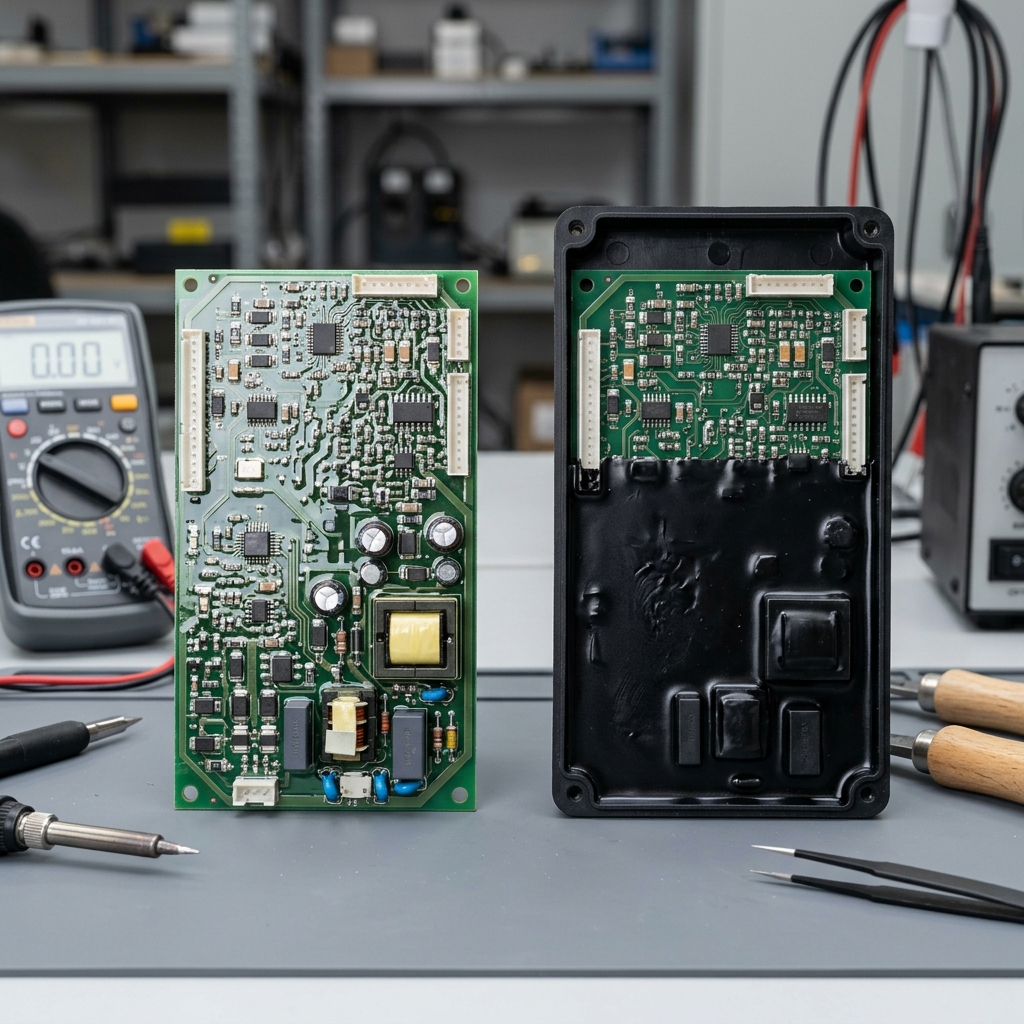
Potting and conformal coating are often grouped together because both can protect a PCB assembly from moisture, dust, chemicals, and environmental exposure. In practice, they are very different manufacturing choices. Conformal coating is usually a thin protective film over the board surface. Potting fills a cavity, enclosure, or selected area with a much larger volume of resin. One preserves access to more of the board; the other can provide much more complete physical encapsulation.
The correct choice depends on the failure risks the product is trying to control. A board inside a ventilated industrial enclosure may need a well-defined conformal coating process. A sealed outdoor sensor, vibration-exposed module, or high-voltage assembly may need partial or full potting. Some products use both, but that should follow a process review rather than a generic rule.
This article compares potting vs conformal coating from the point of view of design, manufacturing, test, repair, and supplier handoff. For deeper detail on dispensing equipment, resin changeover, vacuum capability, and staged filling, see the PCBA potting process guide.
What Potting and Conformal Coating Do for PCB Protection
Conformal coating is a protective layer applied over the surface of a PCB assembly. It generally follows the contours of components and conductors while leaving the board recognizable and, in many cases, more accessible than a fully encapsulated assembly. It can help reduce exposure to humidity, dust, corrosion-related contaminants, and some chemical or thermal stresses when the design and application process are appropriate.
Potting, also called encapsulation in some projects, uses a resin to fill a defined volume. The resin may surround components, wires, and board features inside an enclosure or cavity. That additional material can provide stronger environmental isolation, mechanical retention, and insulation coverage, but it also changes mass, heat flow, stress behavior, and access for service.
Neither method automatically makes a product reliable. Protection still depends on surface preparation, material compatibility, masking, cure, geometry, coverage definition, test sequence, and the actual field environment. The question is not “which method is better?” It is “which failure mechanism and product constraint are we trying to address?”
Key Differences in Coverage, Thickness, Weight, and Repairability
The practical contrast is easier to see when the methods are compared as manufacturing systems.
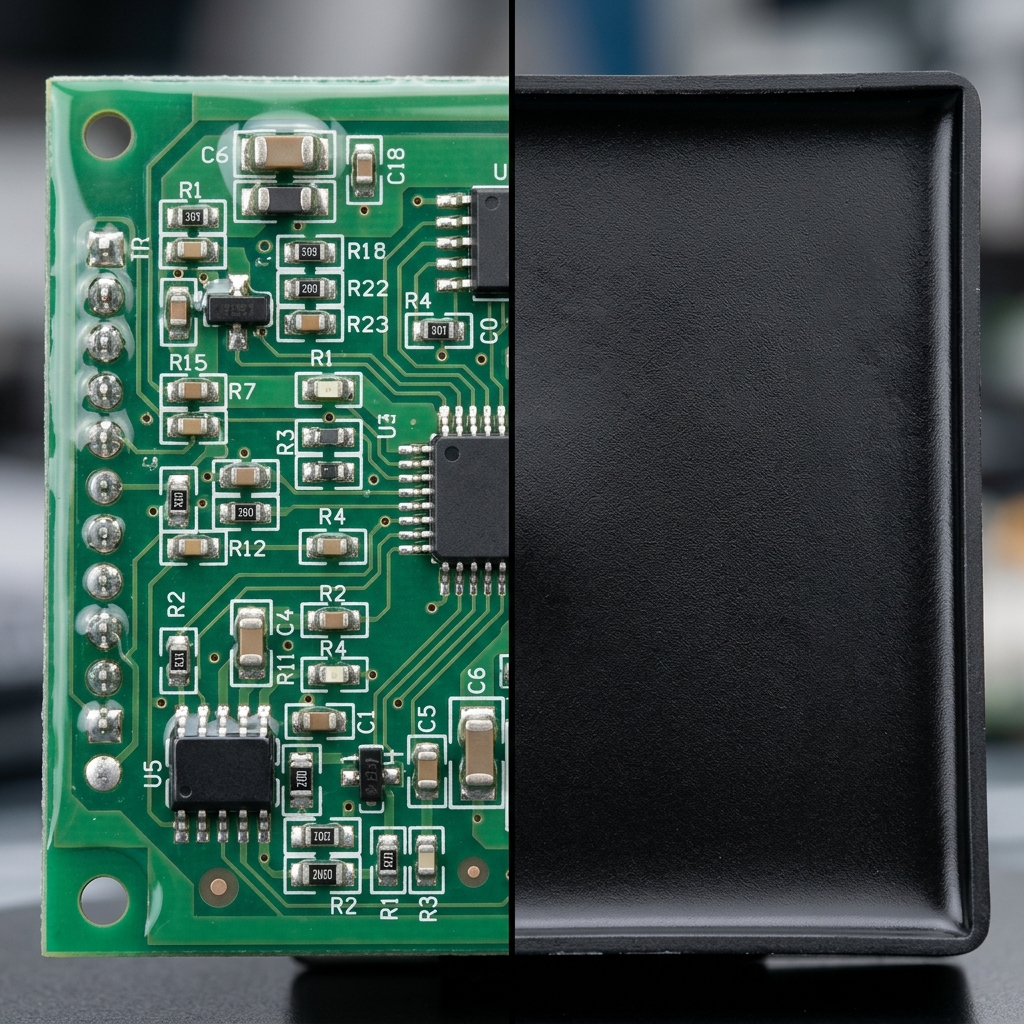
Visual comparison highlighting the difference between a thin conformal coating layer (left) and full encapsulation with thick potting compound (right).
| Decision area | Conformal coating | Potting or encapsulation |
|---|---|---|
| Coverage | Thin film over selected board surfaces | Resin fills a cavity or selected assembly volume |
| Material volume | Relatively low | Significantly higher |
| Added weight | Usually limited | Can be material, enclosure, and fill-height dependent |
| Access after cure | Often more serviceable, though removal can still be difficult | Frequently limited; rework may be difficult or impractical |
| Mechanical retention | Usually not the primary function | Can provide substantial component or wire retention |
| Heat and stress effects | Depends on coating chemistry and thickness | Must be reviewed as part of the full mechanical and thermal system |
| Manufacturing inputs | Cleaning, masking, coverage definition, cure, inspection | Material selection, fixture, fill geometry, dispense control, cure, bubble control, inspection |
This table is a starting point, not a selection rule. A selective potting design can leave key regions accessible. A heavy coating system can still create repair and masking challenges. The final decision must be based on the exact assembly and enclosure.
When Conformal Coating Is Usually the Better Fit
Conformal coating is often the more practical option when the product needs surface-level protection while preserving as much access and low mass as possible. It may fit boards that need protection from humidity or contamination but still require connectors, test points, adjustment features, labels, heat sinks, or later service access.
Typical reasons to evaluate coating first include:
- the board has a relatively open enclosure and needs protection from condensation, dust, or normal industrial exposure
- the product must remain inspectable or repairable after manufacturing
- connectors, switches, LEDs, sensor surfaces, heat paths, or adjustment points need to stay accessible
- added resin mass or full cavity filling would be undesirable
- the environmental requirement can be addressed by a controlled protective film rather than full encapsulation
Coating still needs engineering discipline. Teams should define the coverage area, mask keepouts, cleaning requirement, cure method, inspection approach, and any coating-thickness or material requirements. A coating note without a drawing or clear keepout definition creates avoidable ambiguity during quoting and production.
The PCB assembly process guide provides context for where coating may sit in a broader PCBA flow after cleaning and before final handling or packing.
Application method and coverage control still matter
Conformal coating is sometimes described as the easier option because it uses less material and retains more access. That can be true, but the coating process still needs to be controlled. Selective application, spray, dip, brush, or another method may create different masking, edge coverage, handling, cure, and inspection requirements. The appropriate method depends on the board geometry, volume, material, and coverage definition.
For example, a coating that must avoid a connector, optical surface, heat-transfer interface, test point, or grounding contact needs a clear masking instruction. A board with tight component spacing may also require a coverage review around shadowed areas. The final requirement should describe the intended protected areas and permitted exclusions, not just name a coating material.
When Potting or Encapsulation May Be Necessary
Potting may be justified when a thin surface film cannot address the risk. This can happen when a product needs stronger physical encapsulation, deeper environmental protection, electrical isolation through a cavity, mechanical support for wires or tall components, or a defined barrier around sensitive circuitry.
Applications that may prompt a potting review include outdoor sensors, industrial controls exposed to vibration or contaminants, modules with deep enclosure cavities, products where moisture paths must be managed carefully, and assemblies with a defined tamper-resistance or retention requirement. These examples do not mean every product in those industries needs potting. They simply illustrate cases where the question deserves early engineering review.
The design team should consider what potting changes:
- whether air can escape as resin fills the cavity
- whether a connector, fastener, LED, sensor, label, or test point needs masking
- whether the cured resin adds stress to components during temperature change
- whether the product can still pass functional test after fill and cure
- whether the repair model becomes module replacement rather than board repair
- whether the selected resin affects heat dissipation or enclosure fit
When those constraints are understood, potting can be quoted and controlled as part of the complete PCB assembly service plan instead of being added late as a vague finishing request.
Design and Manufacturing Tradeoffs Teams Often Underestimate
The cost difference between potting and conformal coating is not only the amount of material used. It includes the control work needed to make the result repeatable.
For conformal coating, important work may include cleaning, drying, masking, application setup, coverage inspection, curing, and rework control. The board may need to be handled carefully after coating so that the protective layer is not damaged before final assembly.
For potting, the production plan may also need a fixture, controlled dispense path, resin preparation, material changeover, bubble or void control, cure scheduling, fill-level verification, and a decision about whether one or multiple pours are needed. Those topics are covered in more detail in the PCBA potting process guide.
Test timing is one of the most important tradeoffs. If potting removes access to test points or components, the team should decide which electrical and functional tests must be completed before fill, which checks are still possible after cure, and what happens when a unit fails. The same question applies to coating when a coating layer can affect probes, connectors, or later diagnostic work.
Do not leave repairability to assumption. A product may be designed for repair, controlled factory rework, or module-level replacement. The protection strategy should be consistent with that choice.
Use a product-level decision instead of an industry shortcut
It is tempting to use a rule such as “outdoor products need potting” or “industrial boards need coating.” Those shortcuts do not account for enclosure sealing, mounting arrangement, field-service needs, actual contamination exposure, component sensitivity, or the specific failure mechanism being controlled.
Instead, make a short product decision record. State the exposure, the reason for protection, the critical no-coat or no-fill zones, the expected service model, and the tests that prove the requirement has been met. That record gives the product team, manufacturing partner, and quality team a shared basis for choosing coating, potting, a selective combination, or no additional process at all.
How to Specify PCB Protection Requirements for Quoting and Production
Whether the decision is coating, potting, or a combination, the supplier needs a defined requirement. Helpful RFQ inputs include:
- application environment and relevant exposure conditions
- the required protection method and approved material or acceptable material criteria
- assembly and enclosure drawings with coverage, fill, and keepout zones
- masking requirements for connectors, LEDs, sensors, buttons, labels, fasteners, and test points
- any required cure process, sample approval, visual acceptance, or inspection requirement
- pre-protection and post-protection test sequence
- repair, replacement, and field-service expectations
The quality testing service should be discussed at the same time. A strong handoff connects environmental protection to verification rather than treating coating or potting as an isolated cosmetic step.
Conclusion
Conformal coating and potting solve related but different PCB protection problems. Coating is often a practical way to protect board surfaces while preserving access. Potting can deliver more complete encapsulation and mechanical retention, but it requires stronger definition around material, geometry, testing, cure, and service strategy.
Choose the method from the product's actual risks and constraints. Before production, provide the protection area, material expectation, masking plan, test sequence, and acceptance criteria through the contact page. That makes it possible to review the process before the assembly reaches the line.
FAQ About Potting vs Conformal Coating
Can conformal coating and potting be used on the same product?
They can be used together in some designs, but the order, material compatibility, masking, cure, and test plan should be reviewed for that specific product.
Is potting always more protective than conformal coating?
Potting provides more bulk material and can encapsulate a cavity, but “more” is not automatically “better.” The appropriate method depends on the environmental risk, service requirement, mechanical design, and validation criteria.
Which option is easier to repair?
Conformal coating is often more compatible with later access, but removal can still be difficult. Fully potted assemblies may be difficult to repair. Define the service model before selecting the process.